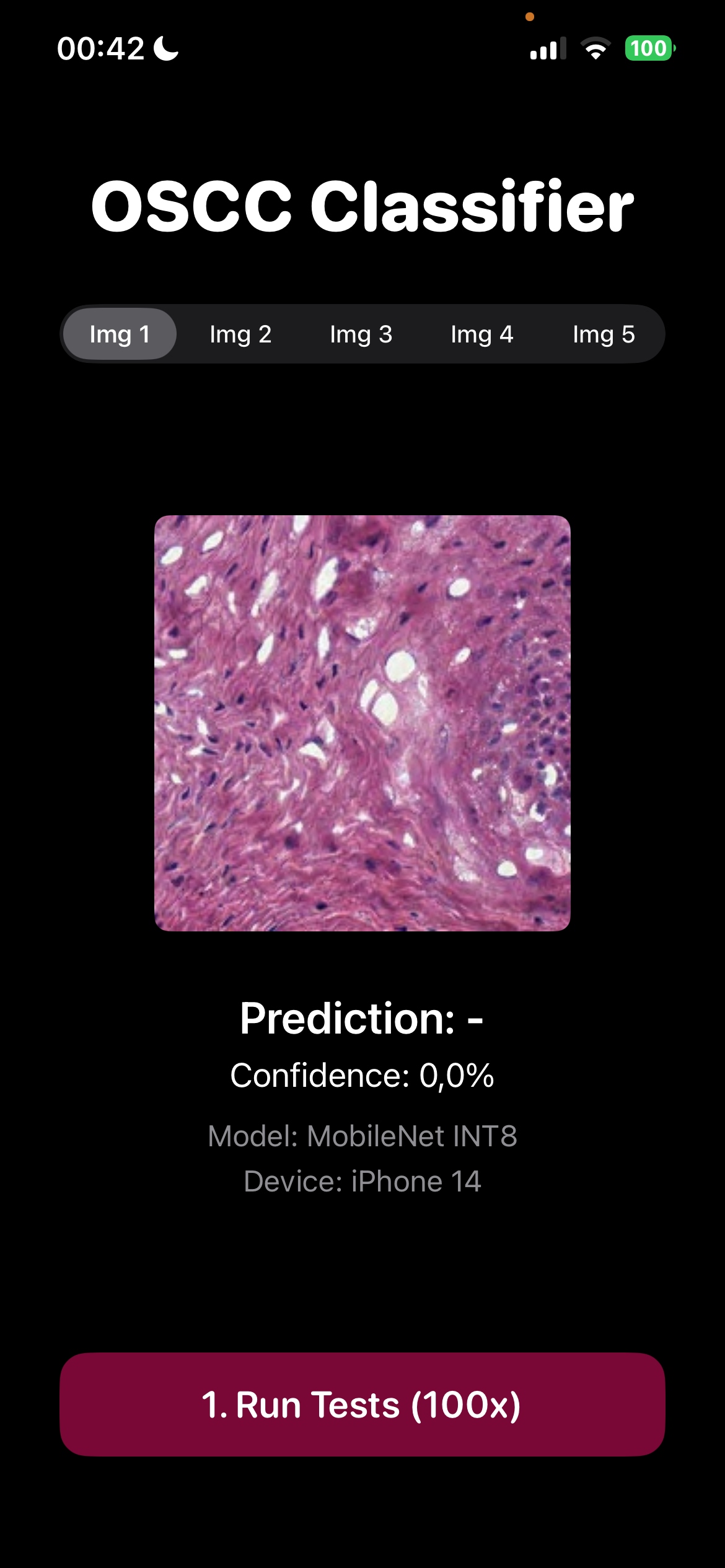
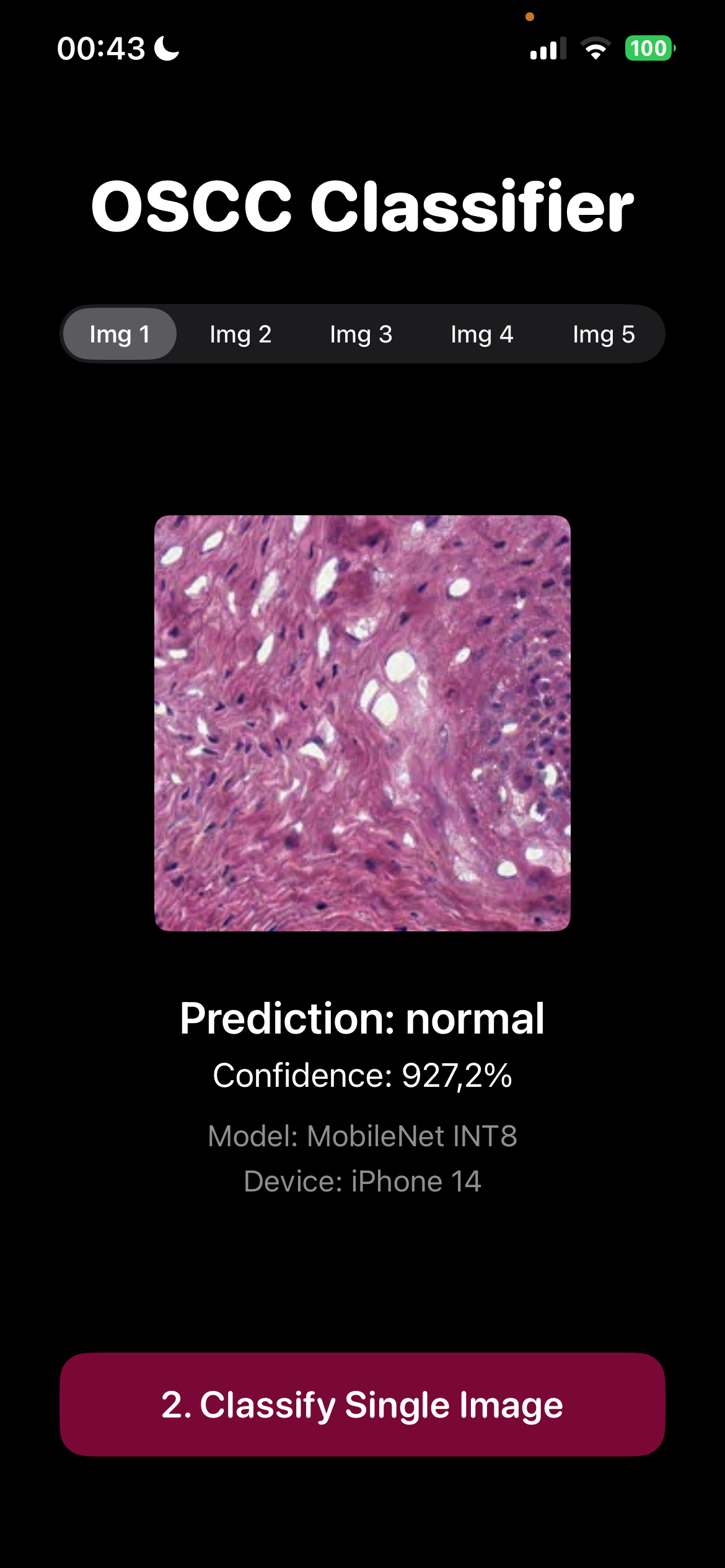
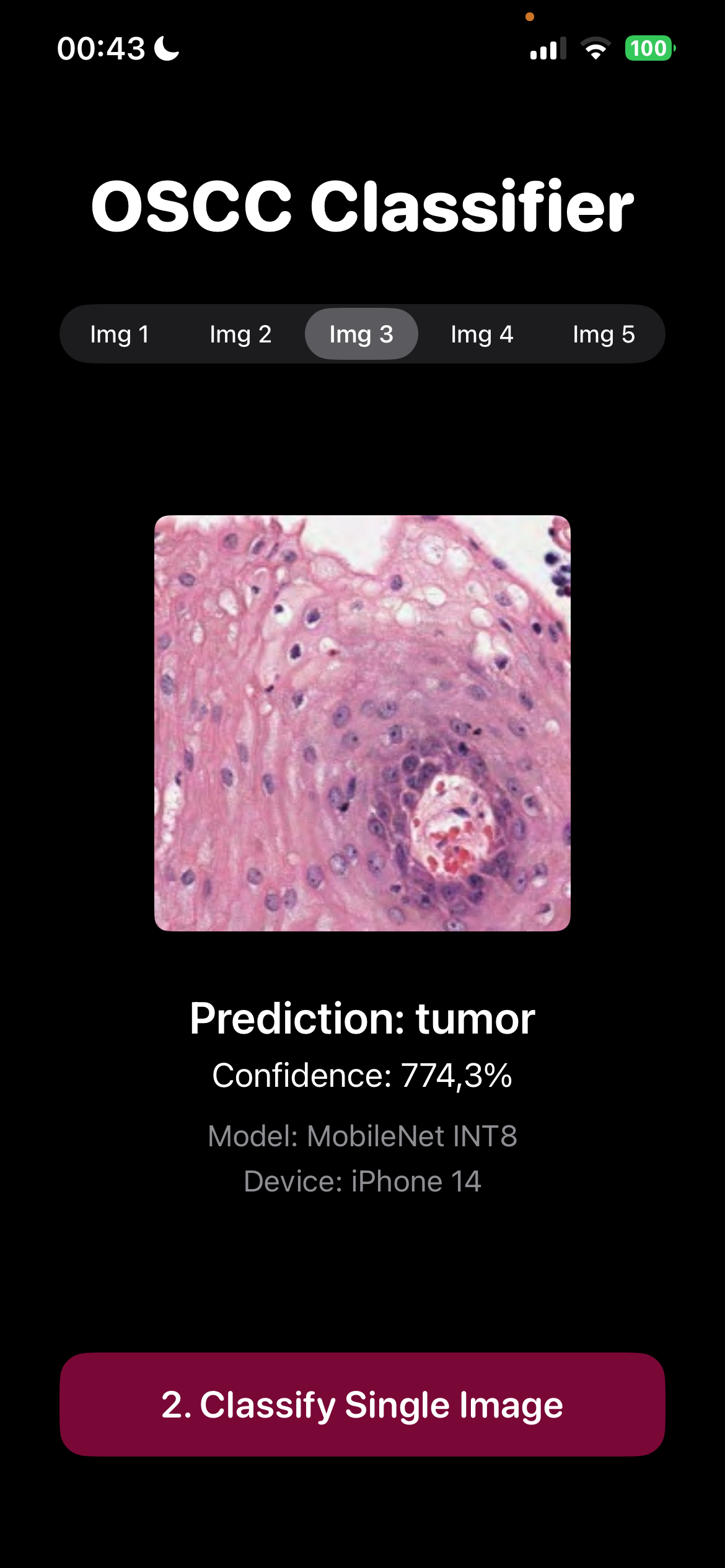
An on-device AI tool that helps dental students learn histopathology by instantly classifying oral cancer tissue samples — directly on iPhone
Learning histopathology is one of the most demanding aspects of dental education. Students must develop the ability to recognize subtle microscopic patterns in tissue samples — a skill that requires extensive practice and, traditionally, close supervision.
Research shows that 71% of dental students struggle with theoretical oral pathology concepts, while 80% report difficulty identifying pathological features under the microscope.1 At the same time, existing AI systems capable of assisting with image classification typically require high-performance hardware and server-based infrastructure, limiting their use in educational settings — particularly in low-resource environments.2
What's missing is a practical, accessible tool that allows students to practice independently and receive immediate feedback, anywhere and without specialized equipment.
OSCC Classifier demonstrates that a lightweight convolutional neural network can accurately classify oral squamous cell carcinoma (OSCC) tissue images while running entirely on a mobile device — no cloud processing or specialized hardware required.
The result is an iOS proof-of-concept application that provides instant AI feedback directly on a student's iPhone. By capturing microscopic slide images and receiving real-time classification results (tumor vs. non-tumor), students engage in a self-guided practice cycle that progressively builds pattern recognition skills and diagnostic confidence.
Reliable enough to give students meaningful feedback — validated at a Macro-F1 of 0.908 (95% CI: [0.786, 0.990]).
Classifications appear instantly — 1.78 ms on iPhone 14 and 13.14 ms on iPhone SE, far below the 200 ms threshold.
Small enough to ship on any iPhone — 4.21 MB after INT8 quantization, a 48.1% size reduction with zero accuracy loss.
Runs comfortably on older devices — using only ~71 MB RAM, even on an iPhone SE.
The lighter model wins — MobileNetV3-Large is 5.77× smaller than ResNet-50 with statistically equivalent accuracy (p=0.469).
Results you can trust — 5-fold patient-level cross-validation with bootstrapped confidence intervals, preventing data leakage.
This project involved designing and implementing the full machine learning and deployment pipeline — from histopathology image preprocessing to real-time inference on iOS devices.
This thesis establishes the technical foundation. Future iterations envision a richer educational experience — validated first by pathologists, then evaluated with students in real learning contexts.
Highlight regions of diagnostic interest so students can see what the model focuses on.
Identify and annotate specific histopathological structures to guide students toward essential diagnostic features.
Expand beyond binary tumor/non-tumor to cover additional lesions and differentiation grades relevant to the oral pathology curriculum.
Conduct user studies with dental students and oral pathology instructors to assess real educational effectiveness and usability.
Bachelor's Thesis Project
Bachelor of Science (B.Sc.) — Computer Science
IU International University of Applied Sciences
Author & Developer
This project demonstrates how modern deep learning models can be compressed and deployed directly on mobile devices — opening the door for practical, accessible AI-assisted learning tools in medical and dental education.